Friday, 11 August 2023

Play dough, Robots, and Sharing the Joy of Creativity

Learning all about letter Rr

Learning the alphabet can be a lot of fun, especially when you're exploring a cool letter like 'R.' We recently had a great time learning about 'R' at GTS, and here's how we did it! 

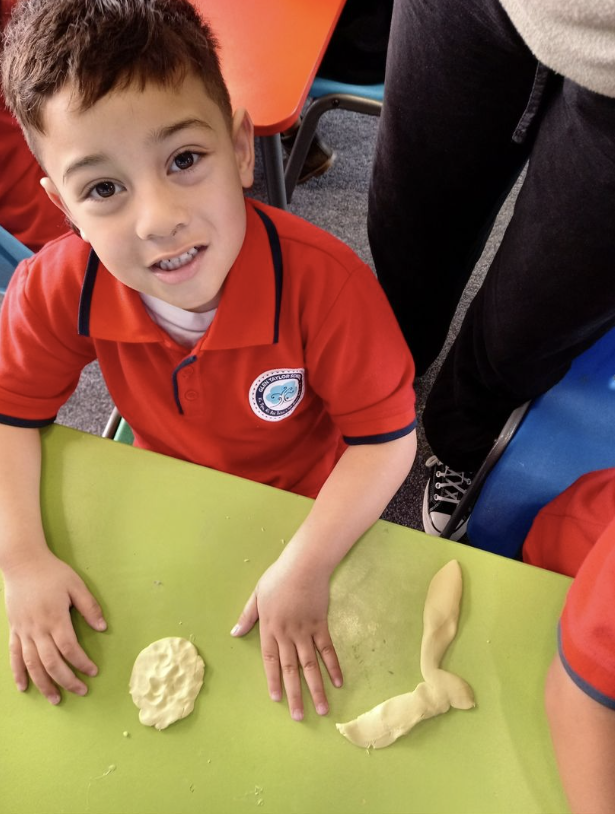
To begin our 'R' learning journey, we incorporated a hands-on approach using play dough. Play dough is not only a fantastic sensory experience but also a fantastic tool for reinforcing the shape and formation of letters. We rolled, moulded, and manipulated the play dough to create the letter 'R.' 
 This helped us understand what 'R' looks like and how to write it.
 

But we didn't stop there! We wanted to be super creative, so we decided to make robots using recycled stuff like old cardboard boxes, bottle caps, and a variety of other recycled materials. It was like a big arts and crafts project. Each robot we made had something special about it.

After we finished making our unique robots, we wanted to show them off to everyone in our school. So, we had a little walking exhibition where we displayed our cool robots to each class. It was awesome to see how different and creative our robots turned out to be.

Perhaps the most heartwarming part of this journey was the involvement of our senior students.  Their genuine interest in the projects, the thoughtful questions they asked, and the encouragement they provided made the little ones feel like amazing artists. 

In the end, learning 'R' was not just about reading and writing. It was about having fun with play dough, using our imaginations to create robots, and sharing our creativity with others. Learning can be exciting when we get to be creative and share with friends. The letter 'R' is now our favourite letter!


Wednesday, 2 August 2023

Exploring the Stars: Matariki-inspired Star Patterns

 Stars have always fascinated humans with their twinkling beauty in the night sky. For generations, people from various cultures have looked up to the stars for guidance, inspiration, and storytelling. In New Zealand, the Māori culture celebrates a special cluster of stars known as Matariki, which signals the start of a new year and the winter season. 

During Term 3 will explore the Matariki star cluster, its cultural significance, and how we can use it as a foundation for teaching and learning. We'll also share a fun activity of creating star patterns and extending them further, allowing young minds to engage with math and cultural awareness.

For the Māori people, Matariki holds immense cultural significance. It's a time for reflection, celebration, and connecting with the land and community. During this time, families come together, share stories, sing songs, and learn about their ancestors and traditions.

Matariki offers a rich platform enabling young learners to explore multiple facets of learning.

Mathematical Thinking: Creating star patterns involves spatial reasoning and geometry. Students can experiment with shapes, sizes, and angles while developing problem-solving skills.

Creativity: Students can express their creativity by designing unique star patterns, enhancing their fine motor skills and imagination.

Creating Matariki-inspired Star Patterns

Materials Needed: Geometrical shapes

While they work on their star patterns, discuss the shapes they are creating (e.g., triangles, squares, pentagons) and how these shapes relate to the stars in the night sky. How can you extend the pattern further?

Finally, students share their star patterns, talk about what they learned.

As educators and parents, let's continue to inspire our youngest learners to reach for the stars, both in the sky and in their quest for knowledge and understanding. Happy Matariki!


This little learner struggled with the more structured learning environment, he often does not participate in learning activities. Celebration time!!! He participated and did an amazing job!!
So proud of him - just goes to show the importance of hands-on activities and learning through play is.


Thursday, 27 July 2023

Parent Survey 2023 link to form


Here is the link to the Google Form I created for my parents: Parent Survey Editable Form
The questionnaire aimed to gather information about a child's transition to primary school. Respondents provided insights into their child's preferences, concerns, expectations, and the support they plan to provide. 
Here are the key findings:

Activities at home: The children enjoy a range of activities such as playing games, helping out, writing, drawing, exploring outside, arts and crafts, playing with siblings, imaginative role play games, puzzles, and reading.

Upsetting factors: The children may be upset by not getting their way, conflicts with other children, feeling put down, not being listened to or understood, someone ruining their work, and not keeping promises.

Response to transitioning: Most of the children responded positively, being excited and looking forward to starting school. One child engaged in role-playing school scenarios at home to prepare for the transition.

Desired learning outcomes: The parents expressed hopes for their child to acquire various skills, including academic skills (reading, writing, math), social-emotional skills (relating with others, making friends), life skills (practical skills, time management), and discovering personal interests and passions.

Parental support: The parents intend to support their child during the transition by being available, providing love, encouragement, and support, reminding them to have fun, be kind, and try their best. Most respondents felt their child was transitioning well, but one expressed concern about absences due to illness.

Awareness of school visits: Three-quarters of the respondents were aware of school visits before the child starts primary school, indicating potential engagement in those events.

Interest in home support information: Respondents were divided on whether they wanted information on how to assist their child at home, with an equal number expressing interest and disinterest.

Overall, the questionnaire shed light on children's interests, concerns, and parents' aspirations and support strategies during their transition to primary school.

Ensuring Quality Transitions From Early Years’ Establishments Into Primary Schools: Putting Research Into Practice

Inverclyde Educational Psychology Services, Greenock, United Kingdom

This study focuses on preschool to primary school transitions and aims to explore the elements necessary to support these transitions and foster a nurturing environment for children. The research takes a flexible qualitative approach, promoting collaborative activities to create shared meaning.

Participants, including early years' staff, primary teachers, parents, and pupils, were recruited from a Scottish local authority to engage in qualitative and quantitative activities. Through a Person Centered Planning (PCP) approach and four identified qualitative activities, a transition timeline was co-constructed. This timeline outlines essential preparatory activities for all pupils, including those with additional support needs (ASNs), and highlights examples of excellence in practice.

The intention is to promote consistency of practice across service providers, ultimately enhancing existing procedures for transitions without replacing any positive transition work that may already exist in different contexts. By sharing this study's findings, it is hoped that the process of transitioning from early years' centers to primary schools can be made smoother and more beneficial for all involved parties.

Transitions and changes in a child's daily life can be overwhelming and anxiety-inducing. When practitioners are unaware of these anxieties, they can worsen the situation. Therefore, it is crucial to plan for and support transitions appropriately. One of the six nurture principles in relationship-based practice is supporting transitions, which can positively impact academic achievement.

To ensure successful preschool transitions, it is essential to have activities and events that bridge the gaps that might disrupt a child's learning and development. This responsibility falls on practitioners in both ECEs and receiving primary schools, as well as the broader multiagency team, including educational psychologists. Collaborative efforts among professionals maximise the chances of successful transitions. Moreover, involving parents, children, and families further enhances the process.

For my inquiry I will start with my Stages and plan accordingly and as time permit me to do so.

Aim
• To investigate what should be in place to support transitions.
• To develop a shared understanding of what makes a nurturing transition for children across providers.
• To create a document outlining the values and principles underpinning transitions for children.
Stage 1:

Ethics
Allocate and meet with educators who are willing to participate int his journey to make transitions smoother for the tamariki.
Participants will be made aware of their rights to withdraw at any time and debriefing took place for all.

Design
The overall design of a qualitative and flexible approach that takes an interactive nature to co-create shared meaning of transitions. The initial stage 1 served as an exploration regarding the next steps.

Participants
Methods of recruitment for the investigation are consistent with obtaining active and informed consent from participants. The session is intended for practitioners that included a mixture of early years’ staff, primary teachers and principals

Materials


My intended plan: Getting enough people together to formulate an action plan.
Procedure

• Working together—all practitioners have developed transitional guidance unique to them.
• Consistency of practice could be ameliorated by working from the same guidance.
• Listening carefully to identify people aspirations for positive transitions.
• Identifying strengths and solutions.
• Focusing on what could be possible rather than just what was available. Local authority resources fluctuate yet the focus needed to be upon the creativity of resources.


Friday, 21 July 2023

Hua Whenua for Matariki


A warming and inviting way to bring family and friends together to celebrate this very special date.

For generations, the Māori have relied on Matariki to plan their harvests. During this season, a cherished tradition is to come together and enjoy lovingly prepared kai (food) with our whānau (family), friends, and community.

Hua Whenua, also known as Friendship Soup, is a fantastic choice because everyone pitches in with ingredients from their pantry, fridge, or vegetable garden to create a large pot of hot, nourishing soup. Children can join in by helping gather and prepare the ingredients, which offers many opportunities to learn about Māori culture and taking care of Papatūānuku (the Earth mother).

In our version of Hua Whenua we went to our school garden to see what was ready to harvest: we found celery, kumura and some fresh herbs. We also invited everyone to bring a vegetable from home. While making the soup, we made sure to save all our vegetable peelings to feed them to our worms. This helps our vegetables grow better and tastier, and it reduces waste that would otherwise go to the landfill.

Harvesting our veggies
Let's see if we have everything for our soup?

  
We helped to peel all the veggies


Yummy, all done!!
Dished up and ready to eat!!


Perfect for the cold day!


Since Matariki is closely linked to Ranginui (the Sky father) and the stars, next time we will make tasty star-shaped croutons with cheese and herbs to accompany our soup. 


We used the Matariki Soup recipe from Twinkl.


Monday, 17 July 2023

Matariki overview Learning Slides

Make Matariki shine | CareforKids.co.nz
Introduction

Matariki, the Māori New Year, is a significant cultural celebration in New Zealand. It is a time to reflect, celebrate, and learn about the stars, nature, and Māori traditions. Incorporating Matariki into the curriculum for young learners, specifically Year 0-2 students, can be an enriching experience. In this blog post, we will explore how Matariki learning slides can be used to engaging "Learn, Create, Share" activities.

Why Matariki for Year 0-2 Students?

Matariki offers a unique opportunity to connect children with the natural world and Māori culture. Year 0-2 students are at a crucial developmental stage where they are curious, receptive to new concepts, and eager to engage in hands-on learning experiences. By integrating Matariki into their curriculum, we can foster a love for learning, build cultural understanding, and develop essential skills.

Matariki Learning Slides

Matariki learning slides are digital or printable resources that can be tailored to the specific needs of Year 0-2 students. These slides can include information about the Matariki star cluster.


Wednesday, 28 June 2023

Celebration time with our Science Showcase

At GTS, we're all about making learning exciting and hands-on. This term our focus during LEARN CREATE SHARE was Science, our students got to choose what they wanted to learn about in: (material world)stuff in our world, (physical world)things that move, or living things. What they did with their choices was nothing short of amazing!

We decided to show off our students' hard work with a Science Showcase, and guess what? Loads of whanau came.


It was a big surprise for us, but it shows just how much they care about their child's learning.

Living world - looking at invertebrates like jellyfish - they have no bones!!


Volcano on a lemon??

Material world - it's all about mixing stuff together and see what happens - the WHY?


Our students were like little scientists, showing off what they'd learned with big smiles on their faces. Everyone was so proud.

Physical world - making things move and how can we make it faster or slower. Newton's cradle - this was a very big challenge,  but we persevered and got it in the end!! A few burned fingers from the hot glue gun, but the outcome was mazing!!


Magnet fun - even a bit of magic!!

Doing art with magnets - who would have thought!?

Simple machines - making a ramp for our car we created that can really move!!


Floating - scenario was set. We have a ship and it crashed into some rocks. The ship sank. The people are safe on the island but now we have to make a boat that will float to get the people safely home - what are we going to do. What makes a boat float? It's all about the shape and the load!!!

What made this showcase special was how much everyone loved it. Whanau couldn't stop saying nice things about our teachers and students. We believe in teaching in a fun way that helps all learners. We want to make sure learning is exciting for everyone.


Let's look at our bones - we made a spine!! 

Our hands can move - each little bit of our fingers moved just like a real hand!


We don't do science like you might think. No boring lectures here! Our students get their hands dirty, because learning is messy, and have a blast doing it. They learned about cool stuff like chemicals mixing together, how things move and the wonders of nature. Every moment was a chance to learn and have fun. We are all about failures too - if we try to create and it doesn't work the first time, we can reflect and make it better.

Our students were so excited and curious. They looked like future scientists, engineers, and nature lovers. But most importantly, they looked like children who love learning and exploring.

In a world that can sometimes be confusing, it's great to know our children are getting ready to take on any challenge. The Science Showcase wasn't just about what they learned this term. It was about showing their incredible potential.

We're excited for the future and can't wait to see where their curiosity takes them. Thanks to all the whanau for their support, and congrats to our fantastic students. Together, we're making the future a little brighter and a lot more curious!


About me

KPMG Hui – Preparing to Share My MIT Journey

It was great to be back at KPMG today and to catch up with the MIT crew. A big thank you to Justine and KPMG for once again welcoming us int...