This is my new favourite activity to do with my class. They are engaged and really show improvement in the sentence structure, formulating a sentence orally and confidence.
What is Colourful Semantics?
Colourful semantics is an approach created by Alison Bryan. It is aimed at helping students to develop their grammar but it is rooted in the meaning of words (semantics).
Colourful semantics reassembles sentences by cutting them up into their thematic roles and then colour codes them.
The approach has 4 key colour coded stages. There are further stages for adverbs, adjectives, conjunctions and negatives.
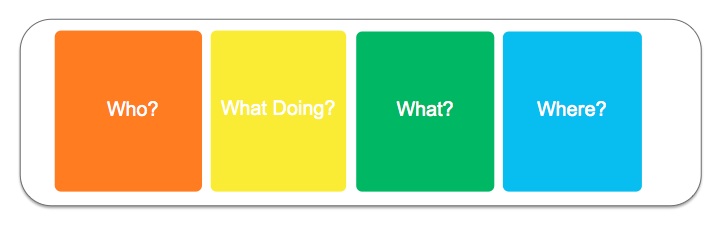

Pictures are also used to help construct the sentences and they are also colour coded to match the above. For example:
- WHO – Orange
- WHAT DOING – Yellow
- WHAT – Green
- WHERE – Blue
Who can use Colourful Semantics?
The approach can be used with students with a range of Speech, Language and Communication Needs including:
- Specific Language Impairment
- Developmental Delay or Disorder
- Autistic Spectrum Condition
- Literacy difficulties
Why use Colourful Semantics?
There are a range of benefits to using this approach, including but not limited to;
- Encouraging wider vocabulary
- Making sentences longer
- Helps students to answer questions or generate responses to questions
- Developing use of nouns, verbs, prepositions and adjectives
- Improves story telling skills
- Can be transferred to written sentences and written language comprehension
- Can be carried out individually or in small groups(up to 3)
Gives students access to a rich set of tools for thinking about language. Students learn to recognise common patterns in sentence construction and then discover how these patterns relate to real life situations. As well as helping students to become fluent communicators, this process teaches them important concepts such as:
• How words combine into phrases and sentences
• What makes up a complete thought
• How different types of word order affect meaning

Colourful semantics helps children understand the structure of sentences. It can be used to colour code and identify grammatical structures. This approach acts as a code helping students to process the otherwise invisible details in sentences. Our block building process can be used to help students play with structure and develop complete sentences. Because students are using a playful tool, the building blocks, the structure can be manipulated multiple times until the students creates the correct sentence. This encourages students to try out new ideas and not be so worried about 'being wrong'. The incremental nature of using building blocks means that students can develop a three part sentence or four part sentence and gradually increase the complexity. Getting the foundations for sentence production right using a colour coding approach builds confidence and autonomy.
How can colourful semantics develop expressive language skills?
You may well have children in your class with a developmental language disorder. Language development in children who struggle with speech sounds and/or vocabulary, is characterised by poor use of syntax and morphology, difficulty producing meaningful utterances, and difficulties comprehending others' messages. Children with phonological disorders tend to produce short, ungrammatical utterances which lack cohesion. They also make frequent errors involving sound-symbol correspondences. Language impairments in children are common. Children with specific language impairment usually display delays in acquiring basic linguistic abilities. In order to succeed in school children need to develop a certain level of academic language proficiency. Children with language difficulties find it difficult to express themselves clearly and coherently. This makes them less likely to participate fully in classroom discussions and more prone to making mistakes.


No comments:
Post a Comment