The Color Monster is a children's book by Anna Llenas that explores emotions through the use of colours. The story follows a monster who is feeling very mixed up and confused, and he doesn't know why. A little girl comes to his aid and helps him to identify and sort out his emotions by assigning a colour to each feeling.
For example, the colour red represents anger, while blue represents sadness. The girl helps the monster to identify his feelings by asking him questions and encouraging him to express himself. As the monster begins to understand his emotions, he feels more in control and less overwhelmed.
We teach the Color Monster to help children develop emotional intelligence and learn how to identify and manage their own emotions. Emotional intelligence is the ability to recognise, understand, and manage one's own emotions, as well as the emotions of others. It is an important skill for children to develop because it can help them navigate social situations, build positive relationships, and make good decisions.
The Color Monster book provide a visual and interactive way for children to learn about emotions. By assigning colours to different emotions, children can begin to recognise and understand their feelings in a concrete way. They can learn how to express themselves in a healthy way, and develop strategies for coping with difficult emotions.
Teaching children about emotions also helps to promote empathy and compassion. When children learn about their own emotions, they are better able to understand the feelings of others. This can lead to more positive social interactions, and help children build stronger relationships with their peers and family members.
The Color Monster can also be used as a tool to help children transition to new situations. Transitions can be difficult for children, and can often bring up a range of emotions such as anxiety, fear, or excitement. By using the Color Monster, I can help children identify and label their emotions during these transitions, and develop strategies for coping with them.
For example, if a child is starting at a new school, the Color Monster can be used to help them identify the emotions they are feeling. They may feel anxious or scared, which could be represented by the color red. By talking about these feelings and assigning them a color, the child can begin to feel more in control of their emotions.
Once the child has identified their emotions, we can work with them to develop coping strategies. This could involve deep breathing exercises, visualisation techniques, or positive self-regulation. By helping children to develop these coping skills, they can feel more confident and prepared to handle new situations.
Using the Color Monster can also be a way to create a sense of community and connection. If children are going through a transition together, they can discuss their emotions and strategies as a group. This can help them feel less alone and more supported, which can be especially important during times of change.
Team Koru has been looking at the different emotions that we feel. Today we created feeling jars and drew things that made us happy, sad, scared, angry, calm and loved.
We also did some blow art for the different emotions.
We are learning to investigate our statistic inquiry. We are getting to know everyone in our team.
Questions we asked: What is your favourite food, game, number, TV show, song, fruit, drink and day of the week. We decided to make a pictograph on our favourite colours. What is your favourite colour? We are learning to find out which is the most favourite colour and which is the least favourite colour in Team Koru.
Alan, our reliever, enjoying some statistics and investigation with Team Koru today.
Fun in Team Koru, our Junior syndicate, as we create our awesome waka. We are learning to use our fine motor skills to make our waka! We are also exploring the materials and resources available. We worked very hard on their determination, perseverance, and creativity, as we coloured, cut and glued our own individual waka.
We impressed our kaiako so much with our AMAZING singing skills and knowledge of Aotearoa's national anthem as it played in the background :)
Our next project was to create our own class waka, focussing on our Identity and where we come from. Creating a sense a feeling of BELONGING. This is one of the most crucial aspects of Transition, making sure the new entrants feel safe and they belong
Our term whakataukī is: HE WAKA EKE NOA - We are all in this together!!
We worked collaboratively and used our fine motor skills to make big letters for our vision and values at Glen Taylor School.
F - Fun, I - Integrity, R- Respect, E - Excellence
This is my case study of 2 of my New Entrant/Year 1 students after 10 weeks of the BSLA program. Before the program was started I did a baseline assessment and after 10 weeks around 40 lessons I completed an assessment.
This is what I found comparing the data collected and compared between the baseline and 10 weeks assessments.
Child A
Was proficient in phoneme identity at baseline assessment.
Has good sound knowledge of phonemes and could recognise both the letters and their sounds.
Below proficiency in all other areas of the baseline data which included segmentation and manipulation of letter sounds, phoneme blending.
At week 10 assessment, child A has made consistent progression in all areas, especially the non-word reading of graphemes.
Next Steps:
Continue to solidify knowledge and build confidence in both whole class and small group BSLA activities.
Moving onto the next stage of BSLA from week 11.
Child B:
Started school with little phoneme and letter sound recognition and knowledge.
Was below proficiency in all areas of the baseline data which included phoneme knowledge, phoneme blending, segmentation and manipulation.
At week 10 assessment, child B has made progress in all areas, especially the non-word reading of graphemes.
Next Steps:
Continue to build competence and confidence in the segmentation of sounds and and decoding strategies - aiding in the ability to read any given word and manipulation strategies with a more intensive focus on phoneme awareness
How did I differentiate my teaching methods to assist my focus students:
Ensuring that I had smaller groups made it easier to see who was mastering the lesson goals and skills acquired to move on. Students that were struggling to learn and retain the new phonemes that were being introduced, I placed into another group where I could be more explicit in my teaching of phonemes, segmentation and decoding.
Hands on and digital rotation activities were set up for the students during our literacy block that related to the oral language, CVC words, and phonemes that were being explicitly taught in both whole class and small group activities.
Weekly handouts and optional homework was sent home that correspond with the learning happening within the class for each group, in hopes that it would aide in the solidifying of the learners phoneme knowledge.
Creating a word wall with both the shared reading book covers and the key vocabulary. This made the key vocab not only continuously accessible but also made the learning rewindable as I would point to a book cover and have the learners take turns to retell the story, and what the words meant. This built confidence for both my focus students in their oral language and comprehension of what we had read.
Due to COVID we did not get to meet with the whanau at the beginning of the year as we had initially planned. Whanau were invited to a BSLA information meeting at the end of term 2. In some ways, I think this worked in our favour, as we had a better understanding of the approach and could share the learning and progress we had seen so far. We had a great turnout of parents who seemed very interested and happy for their children to be a part of the structured literacy approach that we were implementing.
I have enjoyed participating in and implementing the BSLA into my literacy practice.
As a syndicate, we grouped our learners based on what their baseline data showed. Some of my learners made significant progress meaning they moved into another group. I was explicit in my teaching however the challenges of student absences and whānau engagement have impacted how the rest of my group has progressed within the approach.
I am looking forward to taking what I have learned and accomplished this year using the BSLA approach and incorporating it with other structured literacy approaches, such as the Code and the Heggerty program to provide a literacy program that meets and supports all learner's literacy needs and abilities.
How did I engage my students and kept them engaged?
Knowledge of the learner's capacity and scaffolding to the next step apparently all the way through Individual students supported / differentiation provided Explicit teaching is evident all the way through The lesson flowed well despite children not having this delivered to them consistently due to absences etc. Resources all organised and all elements of the BSLA lesson were incorporated.
Some of my students will be doing Tier 2 of the program. They need a lot more reinforcement of their phonetic knowledge. Tier 2 is much more focussed and deliberate teaching.
Here are some activities I included into my Literacy Program: Lots of follow up and reinforcement in activities Lots of vocabulary unpacking with the Shared Reading book Explanations stepped through as began activity Continual feedback and prompting for next step Good flow and pace to keep engagement
In class, we share exciting storybooks that will help grow the number of new and interesting words that your children can use and understand when talking. The words are not every day used words, they are more complex to extend vocabulary usage when speaking. We also focus on 2 Maori words per book.
I like these story books because they are relevant and students understand the content. Here is an example of a book and the vocabulary we focus on. We are also focussing on critical thinking and have extended discussion about the book. We read one book per week to really solidify the vocabulary and the students are able to retell the story.
Here is an example of making the learning visible in the classroom:
This is my new favourite activity to do with my class. They are engaged and really show improvement in the sentence structure, formulating a sentence orally and confidence.
What is Colourful Semantics?
Colourful semantics is an approach created by Alison Bryan. It is aimed at helping students to develop their grammar but it is rooted in the meaning of words (semantics).
Colourful semantics reassembles sentences by cutting them up into their thematic roles and then colour codes them.
The approach has 4 key colour coded stages. There are further stages for adverbs, adjectives, conjunctions and negatives.
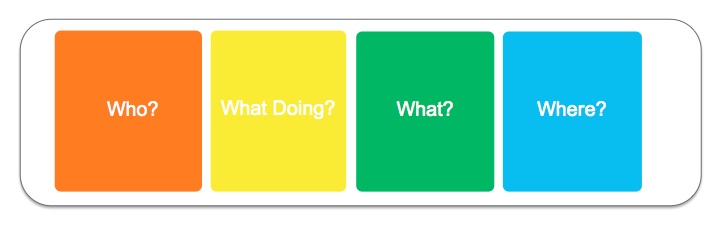
Pictures are also used to help construct the sentences and they are also colour coded to match the above. For example:
WHO – Orange
WHAT DOING – Yellow
WHAT – Green
WHERE – Blue
The approach is used in stages and helps students develop language and vocabulary in addition to grammatical structure. It can be used to help students who are starting to develop language and have limited vocabulary to confident talkers who struggle to organise the grammatical content of their sentences.
Who can use Colourful Semantics?
The approach can be used with students with a range of Speech, Language and Communication Needs including:
Specific Language Impairment
Developmental Delay or Disorder
Autistic Spectrum Condition
Literacy difficulties
Why use Colourful Semantics?
There are a range of benefits to using this approach, including but not limited to;
Encouraging wider vocabulary
Making sentences longer
Helps students to answer questions or generate responses to questions
Developing use of nouns, verbs, prepositions and adjectives
Improves story telling skills
Can be transferred to written sentences and written language comprehension
Can be carried out individually or in small groups(up to 3)
Gives students access to a rich set of tools for thinking about language. Students learn to recognise common patterns in sentence construction and then discover how these patterns relate to real life situations. As well as helping students to become fluent communicators, this process teaches them important concepts such as:
• How words combine into phrases and sentences
• What makes up a complete thought
• How different types of word order affect meaning
Colourful semantics helps children understand the structure of sentences. It can be used to colour code and identify grammatical structures. This approach acts as a code helping students to process the otherwise invisible details in sentences. Our block building process can be used to help students play with structure and develop complete sentences. Because students are using a playful tool, the building blocks, the structure can be manipulated multiple times until the students creates the correct sentence. This encourages students to try out new ideas and not be so worried about 'being wrong'. The incremental nature of using building blocks means that students can develop a three part sentence or four part sentence and gradually increase the complexity. Getting the foundations for sentence production right using a colour coding approach builds confidence and autonomy.
How can colourful semantics develop expressive language skills?
You may well have children in your class with a developmental language disorder. Language development in children who struggle with speech sounds and/or vocabulary, is characterised by poor use of syntax and morphology, difficulty producing meaningful utterances, and difficulties comprehending others' messages. Children with phonological disorders tend to produce short, ungrammatical utterances which lack cohesion. They also make frequent errors involving sound-symbol correspondences. Language impairments in children are common. Children with specific language impairment usually display delays in acquiring basic linguistic abilities. In order to succeed in school children need to develop a certain level of academic language proficiency. Children with language difficulties find it difficult to express themselves clearly and coherently. This makes them less likely to participate fully in classroom discussions and more prone to making mistakes.
Phonemic awareness is essential in teaching students to be automatic decoders of print. The Heggerty Phonemic Awareness Curriculum provides students with consistent and repeated instruction, and this transfers to developing a student’s decoding and encoding skills.
All students participate in the lessons as part of the Tier 1 curriculum. As they grow more confident they may still be developing phonemic awareness skills and may benefit from instruction in the areas of blending segmenting, substituting, and deleting phonemes.
The lessons are designed to provide daily instruction in eight phonological and phonemic awareness skills. Students practice blending, segmenting, and manipulating words, syllables, and phonemes each day. Most literacy curriculum currently available places minimal focus on phonemic awareness, only practicing one to two skills each day.
The two best predictors of early reading success are alphabet recognition and phonemic awareness. (Adams, 1990) With this program, students receive daily practice in both. This explicit instruction scaffolds support for students to work with early, basic and advanced phonemic awareness skills. With daily lessons, students are able to build the necessary foundation to become automatic decoders of print.
The instruction provided throughout the daily lessons can be customised to meet the individual needs of each learner. Teachers can provide support for students through teacher modeling and kinesthetic hand motions and the students stay engaged.
Students who excel can be challenged with advanced phonemic awareness activities that focus on deleting and substituting phonemes, which will help them add new multi‐syllabic words to their sight vocabulary.
Students who have limited proficiency with the English language may benefit from phonemic awareness instruction in their native language. The focus of the lessons is on isolating sounds, blending sounds into words, and manipulating sounds, rather than vocabulary development.
Students can receive explicit instruction in sounds when working with an teacher assistant for additional support. This may be in addition to the instruction that is provided within the classroom. The teacher assistant can provide targeted instruction for specific skills and an intervention lesson may last around 5-7 minutes.
Studies have shown that phonemic awareness is a foundational skill, essential for learning to read. As students learn to identify sounds through oral and auditory activities, they become phonemically aware. Engaging in phonemic awareness instruction develops students’ understanding of sounds, and that knowledge directly impacts their spelling and writing.
First of all, you will want to take a look at what it is. You can download sample lesson plans on their website at this link. They have uploaded a sample plans. (I've been using this Pre-K book with my Transitional New Entrants.) There are also plans from the Kindergarten book and the Primary book.
Start at the Beginning of the Book- (No Matter What Time of Year You Begin)
I heard about it at a professional development course around Structured Literacy and also had a chat with our RTLit teachers. It is designed to be used DAILY and start from Week 1 - do not skip ahead to the week you are in.
Consistency is the Key
Like many skills, consistency is the key to learning phonemic awareness, and daily practice makes the difference! I use the program consistently five days a week. It's actually quite easy to plan for! You just cross off a fifteen minute time block for the Heggerty Book Phonemic Awareness exercises, and turn the page to the next week on Fridays! lt's an easy lesson plan, no prep habit!
Keep the Pace Up
Once both you and the kids know the routine, the quicker you can take them through the exercises, the happier you'll all be! It's easier to keep the kids' attention if you keep the lesson moving than if you go slowly. The kids will get a TON of repetition on every skill, so there is no reason to dwell on each one.
Don't Stop the Lesson Once You Start
Let your class know that you will not call on them if they have questions during the lesson. If someone raises a hand to stop you to ask a question, just shake your head, "no," meaning, "Not right now- wait a few minutes." My students have gotten so good at their Heggerty phonemic awareness lessons that we usually get through them in about seven minutes, not counting singing the ABC song at the beginning and the Nursery Rhyme at the end! Below you can see an example of one of the Nursery Rhyme videos with motions that we do afterwards!
Use Consistent Hand Motions for the Exercises
The Heggerty book includes descriptions of hand motion cues to use for many of their exercises, but not all. Of course, you can always make up your own! But I would highly suggest that you be consistent with your movements. If you teach the kids to "punch the ending sound" one week, then stick with that unless there is a reason to change it. And here is a tip:
And by the way, if your kids don't know all of the letter sounds. Example of songs to do letters and sounds.
Here is an example of how the lesson plan looks like in action.